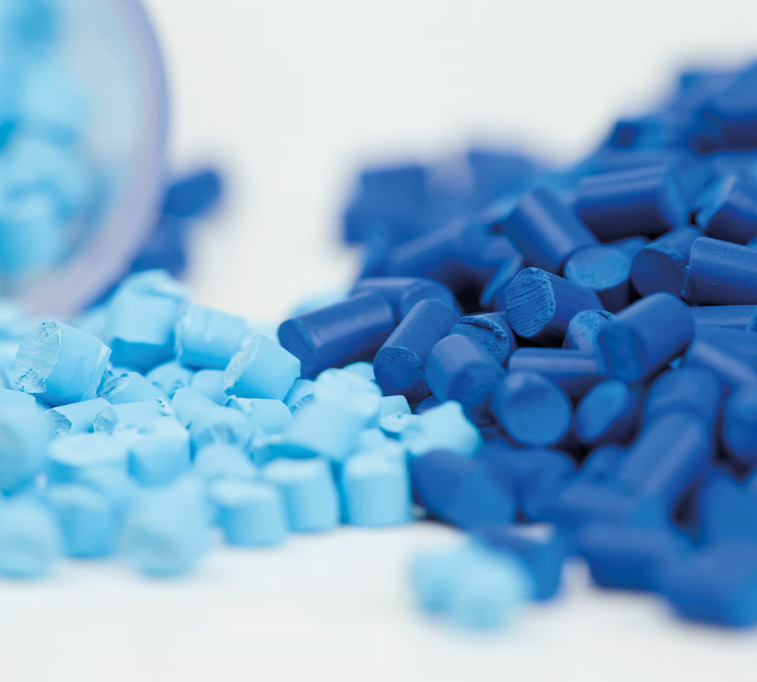
· Raw Material Conveying: In the production of synthetic materials and polymers, polyester mesh belts are commonly used to convey various powdered, granular, or flaky raw materials. For example, in a plastic pellet production factory, the polyester mesh belt smoothly transports plastic raw materials from the storage area to the processing equipment. Its smooth surface effectively prevents the raw materials from sticking or clogging during transportation, ensuring the smooth flow of the production process.
· Intermediate Product Conveying: When raw materials are initially processed into intermediate products, the polyester mesh belt is responsible for transferring them from one processing stage to the next. For instance, in the fiber manufacturing process, the polyester mesh belt conveys the freshly spun primary fibers to subsequent processes such as stretching and crimping. Its good flexibility and precise transmission performance ensure that the fibers do not undergo excessive stretching or deformation during transportation, maintaining the quality stability of the product.
· Film and Sheet Molding: In the production of synthetic films and sheets, the polyester mesh belt plays a crucial role. As part of the molding equipment, it supports the material being molded, helping it achieve a uniform thickness and surface smoothness. For example, in a polyester film production line, the polyester mesh belt carries the liquid polyester material between cooling drums, facilitating its rapid cooling and molding. At the same time, it ensures that the film surface is free of defects, meeting the requirements of high - quality products.
· Extrusion Molding: In the extrusion process, the polyester mesh belt assists in transporting the extruded polymer material to the shaping device. It can adapt to extrudates of different shapes and sizes, ensuring that the material maintains its shape stability during transportation. Moreover, by adjusting the speed of the mesh belt to match the extrusion speed, the length of the product and production efficiency can be precisely controlled.
· Drying and Curing: After the synthetic materials and polymers are molded, they usually need to be dried or cured. The polyester mesh belt can serve as a conveying carrier in drying equipment or curing furnaces. Its high - temperature resistance enables it to operate stably in the corresponding temperature environment. For example, when producing thermosetting plastic products, the polyester mesh belt transports the molded products through the curing furnace, ensuring that the products are uniformly heated during the curing process and improving the product's performance and quality.
· Cutting and Packaging: After the products have completed post - processing operations such as drying and curing, the polyester mesh belt conveys them to the cutting and packaging stations. Its precise positioning function ensures accurate product sizing during cutting. Meanwhile, during the packaging process, the smooth operation of the polyester mesh belt helps improve packaging efficiency and ensures the neatness and aesthetics of product packaging.
· Raw Material Filtration: At the beginning of the production of synthetic materials and polymers, stainless - steel wire meshes are used to filter impurities in the raw materials. For example, in rubber production, stainless - steel wire mesh filters are used to remove particulate impurities from rubber latex, ensuring the quality of rubber products. Different mesh numbers of stainless - steel wire meshes can be selected according to the characteristics of the raw materials and production requirements to achieve precise filtration.
· Separation During the Reaction: In some polymerization reactions, stainless - steel wire meshes can be used to separate substances in different phases. For example, in emulsion polymerization reactions, the separator made of stainless - steel wire mesh can effectively separate the polymer emulsion from unreacted monomers or other impurities, improving the purity of the product and the efficiency of the polymerization reaction.
· Mould Lining: Stainless - steel wire mesh can be used as a lining material for moulds in the forming process of synthetic materials. Its high strength and corrosion resistance can ensure that the mould does not deform or corrode during repeated use. For example, in the mould for manufacturing large - scale plastic products, using a stainless - steel wire mesh lining can help the plastic products demould better. At the same time, it improves the service life of the mould and reduces production costs.
· Reinforcing Structure: In some synthetic material products that require enhanced mechanical properties, stainless - steel wire mesh can be added as a reinforcing structure. For example, when manufacturing high - strength polymer pipes, embedding stainless - steel wire mesh in the polymer matrix can significantly improve the compressive strength and wear - resistance of the pipes, meeting the needs of different engineering applications.
· Mesh Screening Inspection: In the quality inspection of synthetic materials and polymer products, stainless - steel wire mesh sieves are used to detect the particle size distribution of the products. For example, in plastic pellet production, different - aperture stainless - steel wire mesh sieves are used to screen plastic pellets to determine whether their particle size meets the production standards, ensuring the consistency of product quality.
· Impurity Detection Assistance: Stainless - steel wire mesh can also be used to assist in detecting impurities in products. Passing the product through the stainless - steel wire mesh and observing whether there are impurity residues can evaluate the purity of the product. This method is simple and effective, capable of quickly identifying potential quality problems in products and helping to adjust the production process in a timely manner.